
I started training martial arts in 1979, but this past Saturday, July 29th, 2023 at the Bluegrass Games was only the third tournament I’ve competed in. My first art was Tang Soo Do, a Korean kicking-heavy style that I trained in for about 2 1/2 years, but I never competed for reasons I’ll explain later. I had to stop training in 1982 and didn’t resume until the late 80’s, and finding no Tang Soo Do school in Austin, TX I switched to a Korean hybrid style called Tukong Musool. As a white belt I competed in hyung (kata) in a tournament held for all the branch dojangs of that style, and I was surprised when I came in third. They had many of us run our hyung at the same time and in order to avoid colliding with the others I paused during mine. I didn’t expect to win anything, so I was quite happy with third place, but the lesson I learned was “don’t stop.”
A couple of years later I got married and we moved several times to different cities, so although I trained briefly in a few other styles I decided I was probably getting too old for martial arts (hah!) and stopped taking classes. This was sometime around 1997. Fast forward about a decade, and I was looking for a martial art for my daughter Devin. The head of the guitar department at the University of Texas Brownsville, where I was teaching music at the time, was a 3rd degree black belt in Tae Kwon Do, but he was also a blue belt in Brazilian jiu-jitsu at a Royce Gracie affiliate school in town. As soon as Devin turned 5 – the minimum age the school would allow kids to enroll – I started her training at Garcia Brazilian Jiu-Jitsu. A year later, feeling the urge to jump back into martial arts, and also wanting to help Devin through a rough patch she was going through in training, I signed up myself. I was 53.
It was in my early days of training Gracie jiu-jitsu that I decided to compete in an in-school tournament. Unlike the Tukong network of schools, Garcia only had the one small school, so there were only five of us competing. The others were all guys in their early 20’s. In jiu-jitsu tournaments the objective is to get your opponent to tap out from a submission, which to put it simply is either a choke/strangle, a joint lock, or pressure on a muscle or tendon. I was no match for a couple of these young guys and got submitted fairly easily, but I tied for 3rd place after beating one guy via ground control (no submission).
So that’s the extent of my tournament experience leading up to this past Saturday. One of the main reasons I’d never competed much was (is) the concern for damaging my hands, which as a professional musician is a legitimate reason when you depend on those hands for your income. But if I’m being honest with you, another major reason for not competing was simply being afraid – afraid of general injury (and not having insurance until I was married), afraid of being beaten publicly, and just afraid I wouldn’t be up to the challenge. I grew up small for my age and weak from chronic asthma, so I’d already had plenty of humiliating experiences not being able to hang with my classmates in sports and physical conflicts.

So why did I choose to compete in this recent tournament, in particular in stand up sparring? Cliché as it may sound, I’m running out of time. I still enjoy excellent health, strength, speed, and stamina for my age, but Father Time eventually beats all challengers. It was now or never, so I chose now. If I lost my matches, got injured, or what have you it mattered less at this point than actually getting out and doing it. Now that I have, here are my recollections and some things I learned, which were valuable to me and I hope can be of value to you as well.
The first event I participated in was empty handed forms, aka kata, black belt division aged 46 and up. Let me preface this by mentioning an advantage I have from decades of being a professional guitarist: I don’t get nervous performing in front of crowds, so I wasn’t concerned that I would freeze up or whatever. What I didn’t count on, however, was that I would draw a blank on the kata I chose, Junro Yondan. I started out just fine, but after only a couple of moves I started forgetting the sequences, left out a couple of pieces, and in the same manner as Sensei Ryanne described about her first time competing in kata, ended by facing with my back to the judges. Not my finest hour. If memory serves there were six or seven of us “seasoned” black belts who competed in kata, but I didn’t place at all for obvious reasons. I thought I knew my kata fairly well, but I clearly hadn’t learned it to a competition level. The lesson learned is “more practice,” but also I plan to incorporate more variables in practice, as in running kata more often in different locations in addition to the dojo, practicing them with different orientations to the space I’m in (facing the front wall, facing the front door, facing the back mirror, etc.), isolating and running individual sections, running kata while naming all the techniques and stances aloud, and so on.
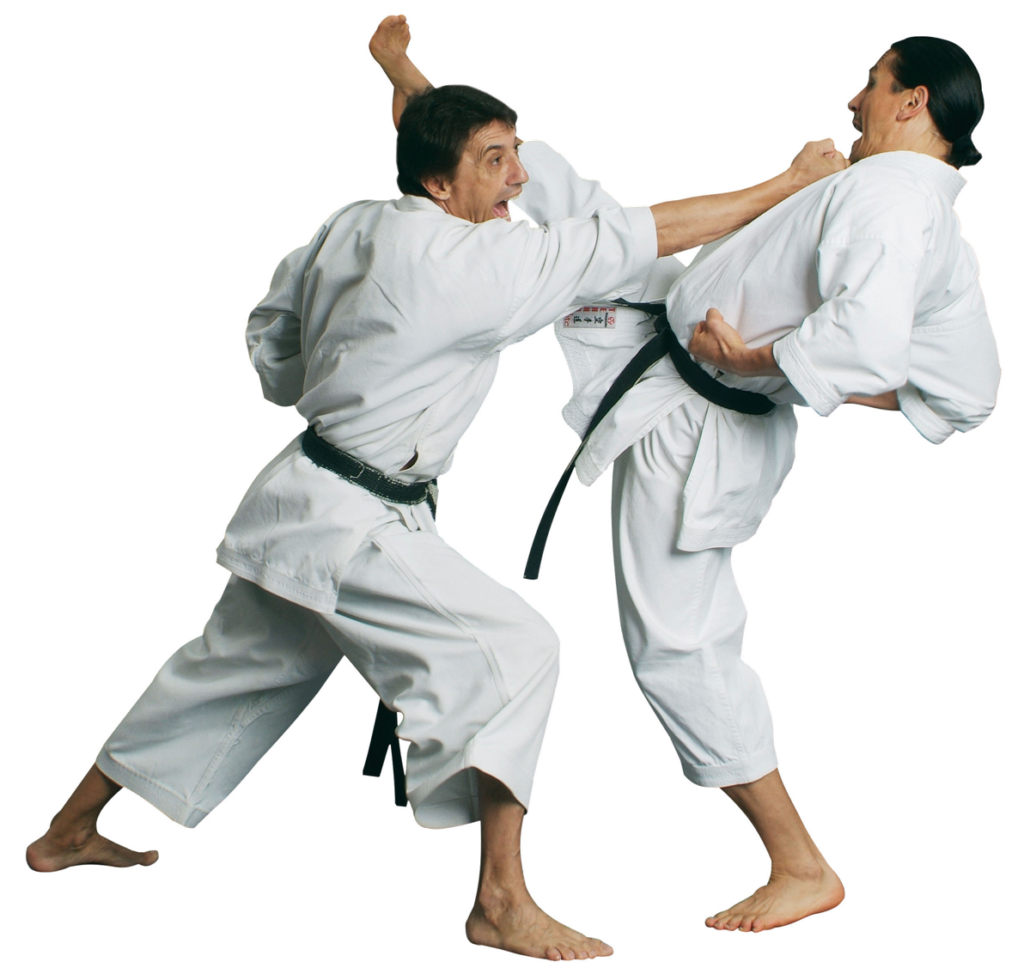
During the 10:00 am mandatory adult black belt meeting we decided to do our kata and weapons competitions early in the day but then allow all the other events and divisions to go ahead of us. This meant that the sparring competition for the black belts was the last event held, and because we had divisions for male and female, 18-30, 31-45, and 46 and over, our male “seasoned” division was the last one to compete. Unlike in kata and weapons there were only three of us willing to spar, Chris Cool, Daniel Thomas, and myself. We drew lots and Chris and Daniel would fight first, and I would fight the winner. I hadn’t met Chris before, but I’d watched his weapon kata using a sword and it was very sharp, pun intended. He definitely had some serious martial skills. I hadn’t actually met Daniel before, but I’d seen him train and knew of his reputation. Those of you reading may know Sensei Almonte’s cousin Lamont from him training jujutsu and Iaido at our dojo, but his main school is Daniel’s dojo, Thomas Karate, and their bread and butter is hard conditioning and hard sparring. Daniel and Chris had a very competitive match, and the score at the end of the round was 4-3 points with Daniel as the winner. I’d been warned by Sensei Ryanne before the bouts that Daniel had very good footwork and was tricky to spar, and I’d just seen it in action. Now it was my turn. Daniel quickly scored a point on me, and then I immediately scored one back on him. From then on I tried different strategies and combos, but Daniel was able to stay just out of range or counter so that we either clashed and no point was scored or he scored on me. The bout ended 3-1 in Daniel’s favor.
Here are some takeaways from the sparring. First of all, what I didn’t realize at the time was that the paper I drew when we were drawing lots apparently meant that if I won against Daniel I would take first and if I lost I would still place second. That strikes me as a peculiar way to run things, especially since Chris did statistically better than I did in their match. It would have seemed more fair that Chris and I should have sparred for 2nd and 3rd place, which also would have meant we’d have gotten to fight twice like Daniel did. It seems like an extra five minutes or so over the course of an all day event wouldn’t have been too much to ask for.
Another eye opener was how the rules were interpreted. As a disclaimer, I’m not questioning the decisions of the judges or saying I was treated unfairly, just that I was surprised a few times. Sensei Almonte had mentioned several times in classes that they expect “a bit of contact” in the black belt division, but there were two occasions when I took very hard body shots from Daniel via kicks, one where I thought I might have to stop for a bit, but pressed on. This would have seemed to have warranted an “excessive contact” warning, but there wasn’t one. I also got drilled square in the face once, which is again against the rules and either wasn’t noticed or mentioned. On the other side, at one point Daniel was in a bladed stance almost with his back turned to me, and when I threw a right mawashi geri (round house kick) towards his mid section he threw a counter kick with his right leg, which exposed his groin to my kick. Obviously I hadn’t meant to kick him there, but that’s where it landed and I got a warning for it. Fair enough.
If I had that fight to do over again and was down 3-1 I would try some riskier moves such as head kicks or a spinning back fist. I’d have nothing to lose at that point and might have evened the score some. But as they say, hindsight is 20/20. That said, overall I think I did well all things considered. I was able to last the full round with a professional Karate instructor 17 years my junior, and even gave him a bit of a run for his money. And while I was certainly wary of him as an opponent, I wasn’t afraid. The scared, weak kid that was me 60 years ago is pretty proud of that.If I had that fight to do over again and was down 3-1 I would try some riskier moves such as head kicks or a spinning back fist. I’d have nothing to lose at that point and might have evened the score some. But as they say, hindsight is 20/20. That said, overall I think I did well all things considered. I was able to last the full round with a professional Karate instructor 17 years my junior, and even gave him a bit of a run for his money. And while I was certainly wary of him as an opponent, I wasn’t afraid. The scared, weak kid that was me 60 years ago is pretty proud of that.
So that’s it in a nutshell, my personal experiences as a competitor. Of course I enjoyed watching my fellow dojo mates in their competitions (and congrats to everyone who competed and especially, who medaled!), and it’s with that in mind that I’ll leave you with one final anecdote and hopefully, a useful bit of advice. One of our students was reluctant to enter the tournament but did so anyway, and unfortunately there were no persons in his age group and experience level who entered the competition, so he performed his kata and won the first place medal by default. He said he felt like it was cheating for him to get a medal and I said to him “Don’t. You got the medal because you showed up and no one else did.” And that’s the message: you don’t win medals by sitting on the sidelines. If you’ve ever thought about entering a martial arts tournament, my suggestion is do it. I hope to see you there.
Clay Moore
Jazz Guitarist. Louisville, KY
https://claymoore.com