
The following information was copied from a news letter from Tozando , the martial arts equipment supplier in Japan. The Face of the Japanese Sword was sent in an email to me on August 23, 2024. I was unable to find a direct link to the article, so others could find it for themselves. The information was new (to me) and helpful for my ongoing studies, and as such included on our blog page for others. I hope everyone can visit Japan and stop into Tozando.
The Face of the Japanese Sword
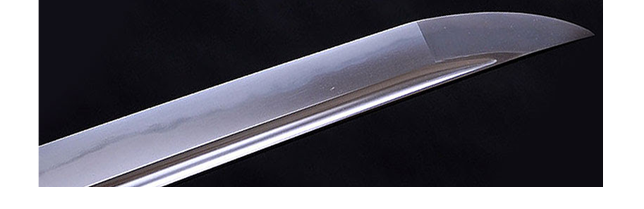
The sharp point of a Japanese katana is called the “kissaki”. It is sometimes also called the “boshi” – hat, but boshi can refer to the kissaki itself or the hamon (temper pattern) that spills onto the kissaki. Kissaki is used more often to avoid this confusion, it is also the terminology most often used in martial arts practice.
When buying and selling Japanese katana; any gashes, marks, or flaws will surely count against the sword in its evaluation. However, whether the flaws are in the body of the sword or at in kissaki makes a huge difference. A common analogy is that the kissaki is the face of the sword, so it is better to have wounds across your body than on your face. Interestingly enough, swords with no identifiable forge have long been called “headless” and deemed valueless by many. As a result swordsmiths took extra care in making the kissaki.
The kissaki is that important in the evaluation and authentication of nihonto, and from a practical viewpoint its sharpness and ability to cut are vitally important. The importance of the kissaki can be seen in the names given to all the different parts in an area of a mere few centimeters.
As you can see from the diagram below, there are many different parts that make up the kissaki, considering this is all in the space of a few centimetres it should give an indication as to how revered the kissaki was. From these many parts the fukura and boshi were particularly singled out by both craftsmen, appraisers and collectors.
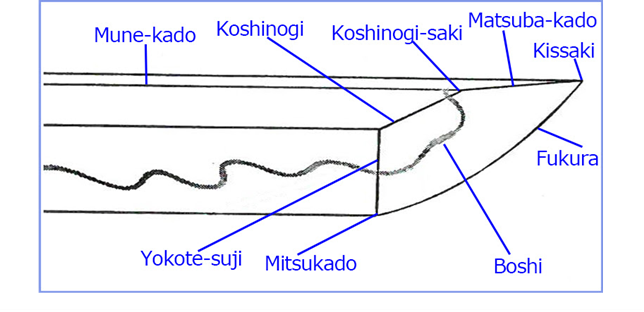
To describe the fukura, people would use words like “kareru” (withered) or “tsuku” (attached). A fukura that has a nice round curve sticking out is called a “fukura-tsuku”, whereas a fukura that does not have much curve and is closer to a straight line is called “fukura-kareru”. One with no curve at all is called “kamasu-kissaki”. Kamasu-kissaki were made in the beginning of the Heian period, albeit for a short period of time.
Today we looked at the kissaki, but the Japanese sword has so many parts with their own individual characteristics which are important in authenticating and dating it. Yet amongst these, the kissaki is perhaps one of the most important parts of the Japanese sword and are a delight to appreciate.